On Digital Theophany, or, Why I Make AI Sacred Icons Considering the growing prevalence of AI generated sacred icons within my body of work, and given the current state of distrust and disrepute regarding AI art, I think it appropriate to offer an explanation of my practice. Firstly, a few remarks regarding art in general. I believe that there are four arenas within which art can operate. These are, put very briefly and risking the appearance of banality: Sacred art, which uses aesthetics as a portal through which the love of God and the presence of the angels can enter into everyday life, indifferent to the social order as it transmits gnosis regarding the immortality of the soul and the imminent redemption of human history; Humanist art, which strives to render truths about the soul and about nature in an ever more refined, precise, and affective way, and hopes to improve the existing social order; Rebellious art, which tears opens holes in institutions and lifeworlds in order that a freedom beyond good and evil can spill out, negating the current social order; Political art, in the sense of pure power acting in a concrete way, establishing quotidian rhythms and creating the lifeworlds that the other three modes of art stand in relation to. My wager, following after the life of Christ, the work of Haela Hunt-Hendrix, and certain contemporary and historical artists who are of great interest to me (Unicole Unicron, JuneStrings and Niko; William Blake, Hilma Af Klint, Wassily Kandinsky, Salvadore Dali), is that the highest form of freedom possible for both the artist, the viewer of art, and society as a whole must involve a full-fledged engagement with all four of these modes of art. In both my art practice in the strict sense and in the ethico-aesthetic orientation of my life as a whole I seek to implement this, however tenuously. AI art tends to lean in one of three directions, which can be understood via the schema outlined above. Slop for slop's sake memes that everyone makes and no one wants as well as practical renderings for businesses comprise the first direction. This can be mapped onto the political art mode, which, being only a demi-aesthetic form of power, is why they are seemingly immune to aesthetic critique. While this mode is the usage that is likely going to have the largest effect on our world, from the perspective of an individual artist it is the least interesting use of AI to me. This is the intended usage of these tools, and thus the power being exerted is immediately that of tech companies and the surveillance state, whose will I am not interested in realizing. The second relates to the humanist mode of art, and usually is using AI to make renderings in an anime or digital semi-realism style in a simulation of professional internet artists. This is AI as the “democratization of art”. Everyone can now have free drawings of their OCs for free and folders full of sci-fi images of brightly colored planets with giant moons. I think the prevalence of this mode will, in the long run, be of net benefit to humanity, as non-AI artists will be forced to abandon the kitsch that the internet attention economy has so far rewarded, though in the short term the effects on professional artists are tragic. This horizon is of little interest to me, however, as AI tools are bloated down with internet kitsch and thus are piss poor at producing the kind of originality and tenderness that define great works of humanist art. For works in this arena kind I'd rather make them in another manner, or, on the consumption side, continue to follow real artists whose work is not kitsch. (A slightly more speculative hope of mine is that the spreading of this mode will force things to the limit in terms of personally fine tuned "treat" content where consumers, brought to a breaking point where the content just can't get any more "perfect" and the fantasy of a more perfect version of whatever obsession defines them can no longer be sustained, will be forced to face their own existential position and strive to acheive real agency outside of consumption.) The third mode, which I identify with surreal shock art and also with attempts to sabotage AI training sets, corresponds to the rebellious mode. This is certainly the most interesting of these uses of AI, in my opinion, and it is one that I have engaged with myself. Its main limitation is that the dryness of the AI creation process, compared to other mediums, struggles to provide the pure sensation involved in both the creation and transmission of a great work of rebellious art.
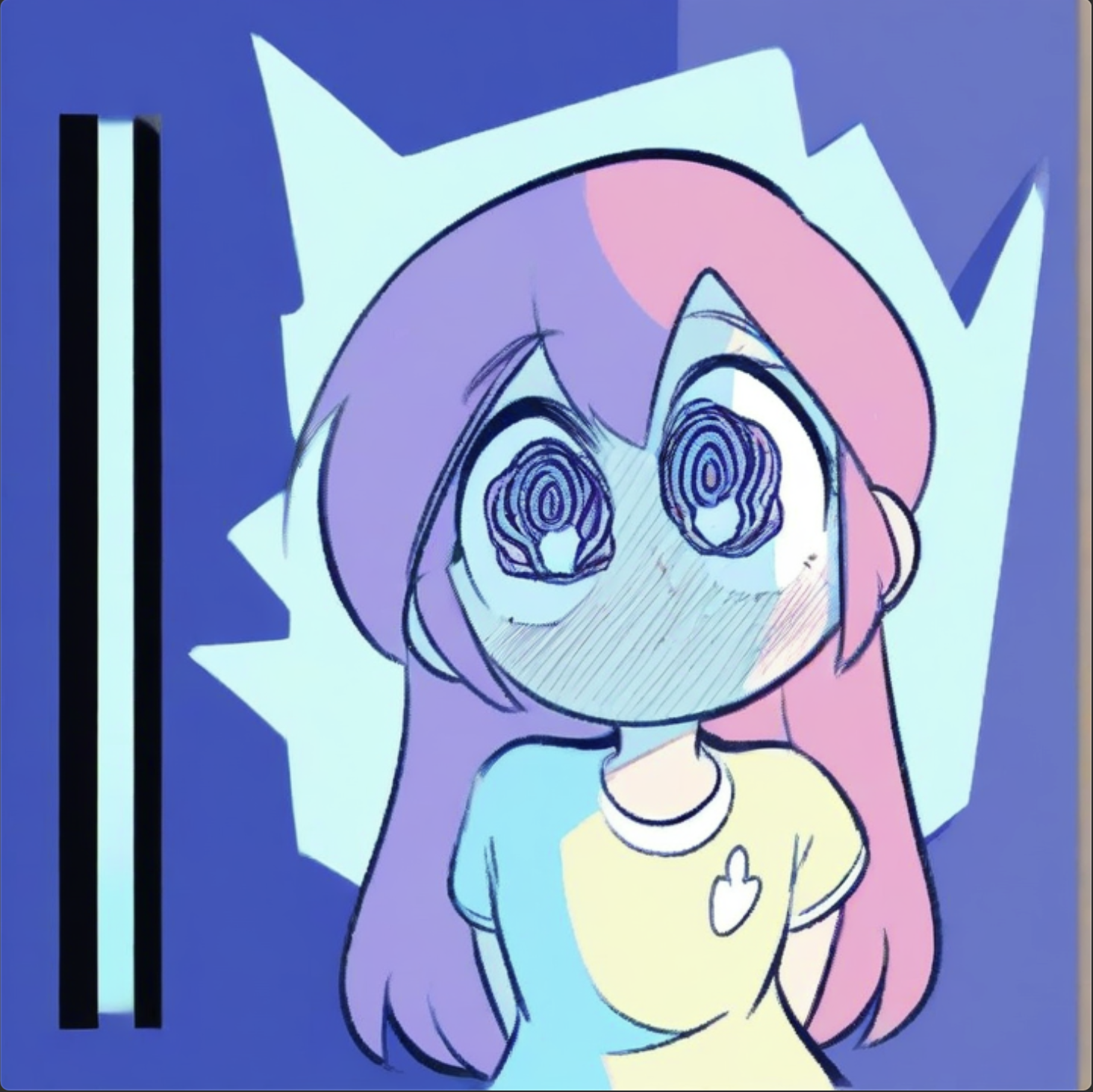
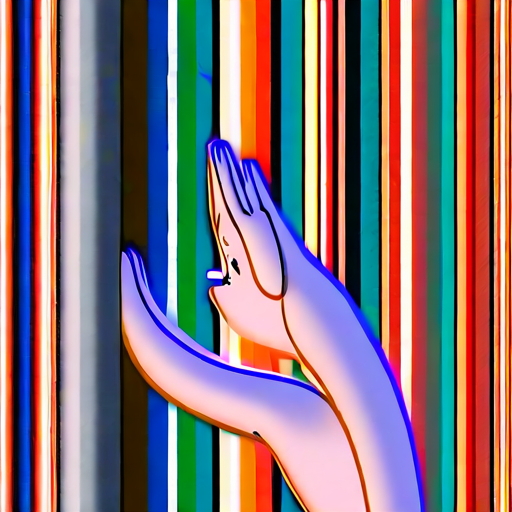
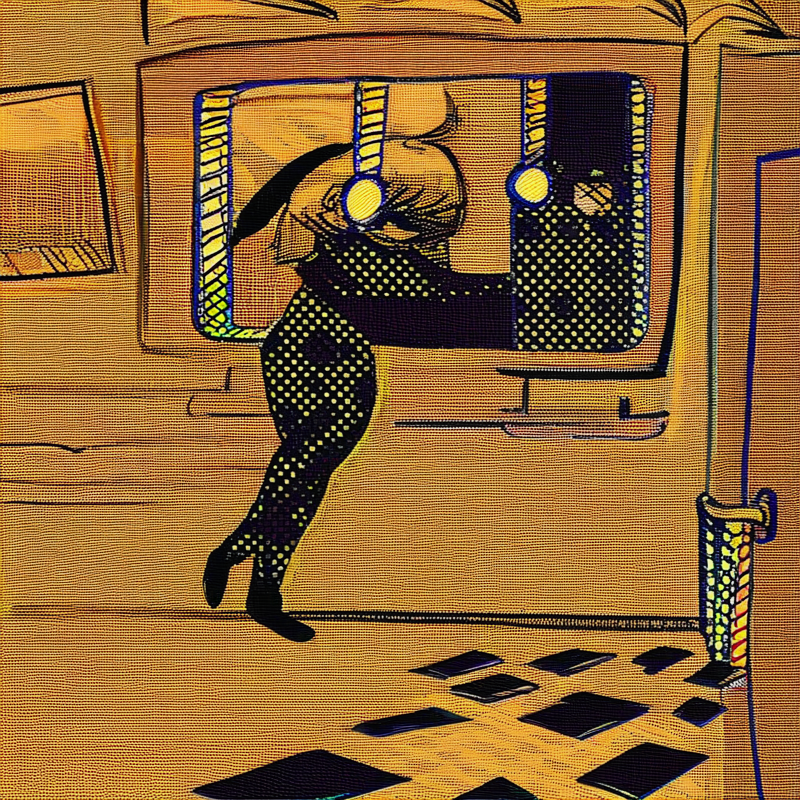
Which leaves sacred art. This seems to be an entirely untapped horizon for AI art, and one that AI is actually quite well suited for with a slight adjustment in approach. The Logos of Christ is an algorithmic description of God infinitely rewriting itself in the action of the Holy Spirit, after all. To create my images, I use KiwiMix-XL, which is a Stable Diffusion XL fine-tune made for anime porn. It being a porn model essentially jailbreaks the model, generating results that are more chaotic and less “professional” looking, and also makes it more able to handle contradictory prompts. It being an anime model makes it good at abstraction and smaller resolutions. I begin with a specific theological theme I have been savoring, and then generate a very large set of images with a prompt that follows that theme, making a few small adjustments along the way but mostly letting the model go wild. This approach is “dumpster diving through the realm of forms”, as a friend put it. I then, over the course of multiple days, sit with the images and meditate on them, finally reducing them to a core set. From a purely human vantage, God is beyond description, beyond capture, and usually elusive, but yet They can appear in flickers and moments in an unmistakable way. My process aims to mirror this, both in the generation of large sets, in the recourse to abstraction, and the patient waiting process (rejecting the instant gratification aspect of AI art, as well). Further, they are created and presented as sets. The seriality of AI art is not nearly dwelt upon enough. A set of AI images instills a sense of awe at the scale of human industry, the power of computation, and the sublimity of math, and I seek to point this awe towards an awe of God and a sense that anything is possible when we cooperate with Their will, similar to how one feels walking into a very grand church. It is also thus less amenable to a satisfying immediate consumption that comes with either an individual art work or an ongoing set of individual releases, though any individual image within the set is chosen because it could stand on its own as an object of devotion. “God of all power, Ruler of the Universe, you are worthy of glory and praise. R: Glory to you for ever and ever. At your command all things came to be: the vast expanse of interstellar space, galaxies, suns, the planets in their courses, and this fragile earth, our island home. R: By your will they were created and have their being. From the primal elements you brought forth the human race, and blessed us with memory, reason, and skill. You made us the rulers of creation. But we turned against you, and betrayed your trust; and we turned against one another. R: Have mercy, Lord, for we are sinners in your sight. Again and again, you called us to return. Through prophets and sages you revealed your righteous Law. And in the fullness of time you sent your only Son, born of a woman, to fulfill your Law, to open for us the way of freedom and peace. R: By his blood, he reconciled us. By his wounds, we are healed.” -Book of Common Prayer, Eucharistic Prayer C Icon Gallery