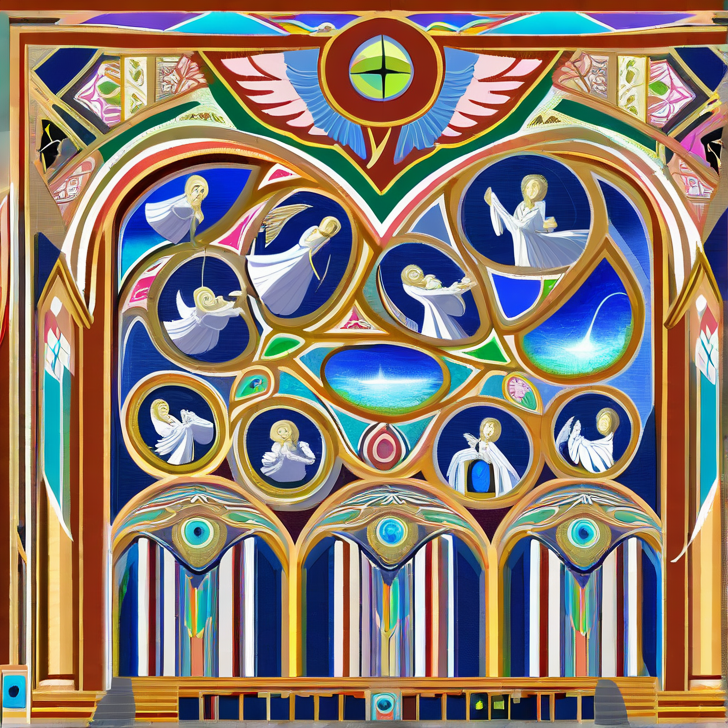
This series is ongoing and unfinished. Preface: Why Pray? Introduction: Mysteries Form Part 1: Cyclicality and Change
Preface: Why Pray? Why pray? Put in pragmatic terms, it will make your life better. If you pray regularly, you will eventually find yourself in a deeper connection with yourself and your own core desires, as well as with a sense of meaning and purpose in the world around you. Also, you might just might find yourself in touch with God and other entities in the celestial world. Or not. Believing today necessitates being able to simultaneously hold God as both dead and alive. It is possible, and even necessary, to both approach prayer with sincerity and reverence, but also to be able to acknowledge/interrogate its pragmatic nature and its effects as checked by reason. That said, the rosary "works" from both of these perspectives, and in fact explores this split in its own way, which will become especially clear throughout the meditations on the mysteries later in this series.
Introduction: Mysteries This will be a series on the rosary, which I think is both a beautiful prayer system, as well as an incredibly profound nexus for speculative contemplation. I was originally familarized with the rosary growing up as a Roman Catholic, where I'd pray it quite often with my family or at [Catholic] school. After finding God again as an adult, the rosary has quickly become a staple of my [non-Catholic] prayer routine. The rosary consists of two primary elements that play off of each other directly, a well rounded but repetitive set of prayers, and a set of stories to reflect on. The stories in question are called Mysteries. A Mystery in theological terms is a category of aesthetic object that has the following qualities: a confident divine potency of some kind (i.e. there is a certainty that God can speak truth through it in some way), some sort of representative articularity (i.e. you partially can "say" what it is), but, most importantly, it has a evolving quality of infinite inscrutability to it (i.e. its message and meaning aren't exhaustable or graspable in their entirety by anyone or any group or any temporal horizon). Because of these three things, Mysteries should be approached with curiosity as objects of continuous contemplation, and it seems that frequent contemplation of them brings about higher states of consciousness. An example of a Mystery is the nature of the Holy Trinity. There are descriptive dogmas of the Trinity, e.g. that They are three persons but one undivided substance, but the actual "mechanisms" and meaning and significance of the Trinity cannot be known or articulated in full, they can only be "worked on". The rosary centers around a series of twenty Mysteries that are events from the New Testament (with a couple of notable exceptions), divided into four sets. In this series, I'm first going to talk about the structure, prayers, and actual "how to" of the rosary. Then, I will talk about each set of Mysteries in depth one at a time.
Form Part 1: Cyclicality and Change The rosary is prayed in a cyclical, repetitive form, and consists of 7 groupings of prayers: one "intro group", one "outtro group", and 5 "decades" based around the 5 mysteries of the respective set of mysteries, which cycle in a weekly pattern. The Joyful Mysteries are said on Monday and Saturday, the Sorrowful Mysteries on Tuesday and Friday, the Glorious Mysteries on Wednesday and Sunday, and the Luminous Mysteries on Thursday. The set of prayers usually said with the rosary includes prayers both ancient and modern, both "official" prayers and ones with mystical lay origins. The repitition of prayers works to engender a flowstate, giving space for your thoughts to wander from particular to universal, from personal to apocalyptic, and then the decade breaks pull you back in. It takes around 20 minutes to pray, which is both a feasible amount of time for most to do, as well as just long enough for you to really feel pulled away from the world. All of these traits make the rosary perfect as a primary daily prayer tool. The cyclical aspect of the rosary is one I'd like to highlight a little bit. Christianity is deeply concerned with cycles. The cycle falling into sin* and subsequent redemption of the individual soul mirrors the birth, death, and resurrection of Christ**, which also is mirrored by the distinction/separation/creation of reality aside/apart from God*** coming back into some kind of mystical union with God at the end of all things. And this cycle plays out even in the coming and going of days and individual affects. The traditional translation of the ubiquitous Our Father asks God to "give us this day our daily bread". The most common Latin version's equivalent of daily is "quotidianum", from which we get the word "quotidian", the painfully daily. All this to say, Christian religious practice, and especially the rosary, seeks to bring clarity, direction, comfort, and strength to our most mundane everyday reality, but at the same time to challenge us to continually open our hearts and hone our minds to the incredible task of uniting our individual life/will the the universal task of the redemption of human history and an "invasion" of sacred Love into the profane world. We're called to take up our cross and follow Christ every day. Furthermore, this cycle and this process are mysically open and incredibly active, and even retroactive. This will become more clear in talking about individual mysteries, but there is something in Christianity at both an invididual/personal and universal level that's deeply mutable, radically undecided/undecidable. The idea of sin and redemption is not meant to mire one in immanent guilt and self-loathing. In fact, the prominence of wallowing about sinfulness and disempowerment in any given group/strain of Christianity is a sure sign of the intrusion of external, profane power exerting itself and using Christianity as a mechanism of social control. It is Not divine Love. Alternatively, positing of the saved Christian self as elect or complete also poses a danger. Any Christian who feels themselves totally justified by faith alone outside of an ongoing process of moral activity, self-growth, and self-critique is always in danger of elevating their own culturally contingent lifestyle as itself divine, and subsequently it's easy to see how this turns into the kinds of "Christian" hate that are prominent throughout both current American culture and European history generally. A true Christian understanding of life in Christ is one of actively transcending ones own understanding of the world, of truth, of moral goodness, and potentially even of God, fearlessly confronting or even instigating change while holding onto the core truth of God's Love and Christ's death and resurrection. We all fall, we all fail and fail again, and we all change in totally unexpected ways; God is there also and even especially; it is a repitition through which something new emerges. One of the most profoundly spiritual experiences one can have is the retrospective understanding of a wound or a failure as a blessing, a "felix culpa" or happy/lucky fault****. The Holy Spirit, Who can be partially understood as God's ongoing [causing of] evolution at the level of the movement of history and at the level of the human heart, is mysteriously also the same God as God the Father of ultimate unchangeable reality and ultimate beyond, and Jesus, the absolutely singular and particular God-man. Christianity now is profoundly different from Christianity before the advent of the critical philosophical tradition and modern science, as well as from the Christianity of the earliest days after the life of Christ. Faith is, in a way, a process of adaptation. These ideas are critical pieces to understanding/approaching the rosary, in my opinion. *It is important to understand sin in it's most basic definition as separation from God instead of any kind of moralized "Law". In God, we are free in ourselves. Mystically, our most true and most free will is simultaneously God's will. Sin is essentially enslavement or addiction, which can be external or psychological/libidinal, which is a point (not the only one) where Christianity connects with social emancipation and philosophical critique **Remembered and re-enacted yearly in the liturgical calendar and daily with every celebration of the Eucharist ***Which can be thought of either in terms of "the fall" of original sin as the created separating themselves from God, or (more heretically) as the strange fact of creation itself (if God is perfect and complete, why is there anything at all besides God?) signaling some kind of sign of a "problem" in God that is being worked out in/by history ****The question of whether all of human history will "have been worth it" in the manner of felix culpa is one of the Antinomies of Apocalyptic Humanism in Transcendental Qabala. You can also connect the felix culpa with the philosophy of Hegel where a dialectical movement in the universal is connected with a failure in the particular, and the idea of the emergence of necessity from contingency.
This series is ongoing and unfinished. Preface: Why Pray? Introduction: Mysteries Form Part 1: Cyclicality and Change